I am an interdisciplinary social scientist with expertise on global security, political violence, humanitarianism, and international conflict. My research explores these themes from empirical, theoretical, and applied perspectives. Specifically, I study the spread of violence, and security practices across global space; seeking to understand their prevalence, dominance, and historical reemergence. Put differently, I study why violence remains such an intimate part of our everyday life, connecting its most dramatic manifestations – war, genocide, torture – down to its most banal forms – intimate partner violence, social exclusion, and poverty. In short, I want to understand why violence is so central to our lives, and why it is so difficult to change that reality.
Currently, I am Associate Professor of International Relations at the University of Copenhagen’s Department of Political Science. At Copenhagen, I am also Director of the Security Risk Management Program, and Director of the Future of Advanced Security and Technology Research Hub (FASTER). I am also a Visiting Professor at the Geneva Graduate Institute and Principal Investigator for the Future of Humanitarian Design research collective.
Previously, I was Senior Researcher at the Geneva Graduate Institute’s Centre on Conflict, Development and Peacebuilding (CCDP), where I led a research program on global violence prevention. I have also held positions at the University of Ottawa’s Centre for International Policy Studies (CIPS), the International Relations Institute (IRI) of the Pontificial Catholic University of Rio de Janeiro, the Centre for Resolution of International Conflicts (CRIC) at the University of Copenhagen, and the Max Weber Foundation’s Orient-Institut Beirut (OIB) in Lebanon.
My research draws on over fifteen-years of experience conducting ethnographic and other field research in war and crisis-affected regions including the Democratic Republic of the Congo, Iraq, Syria, Palestine, Colombia, Brazil, and beyond. I combine that ethnographic expertise with a plural methodological toolbox, drawing on open source data analysis, visual analysis, microsociology, and other qualitative approaches to dig into the lived experience and ontology of violence, war, and conflict. I also have extensive expertise on participatory methods, both in basic-research projects, and during applied projects where I draw on co-design methods. My research has been published widely at leading international journals and other outlets, and has been the subject of extensive media coverage. I am also currently one of the lead curators for a year-long exhibition on humanitarianism and conflict to be held (2026-2027) at the International Red Cross and Red Crescent Museum.
My applied research pushes my basic research into attempts to affect real world change. Reflecting my transdisciplinary commitment, I have worked with computer scientists, chemical engineers, development engineers, architects, material scientists, doctors, and public health specialists to design interventions aimed at reducing the global burden of political violence and conflict in different ways. At the moment, for example, I am leading a project drawing on machine learning and computerized adaptive testing to develop an adaptive technology for mental health and psychosocial triage in humanitarian settings, in collaboration with organizations like the International Committee of the Red Cross (see ADAPT-MH). Other partners in my applied research activities have included the United Nations Human Settlements Programme (UN Habitat), the United Nations Relief and Works Agency (UNRWA), the Danish Institute Against Torture (DIGNITY), the Swedish red Cross, the Geneva Peacebuilding Platform, the World Bank, the Peace Research Institute Oslo, and beyond.
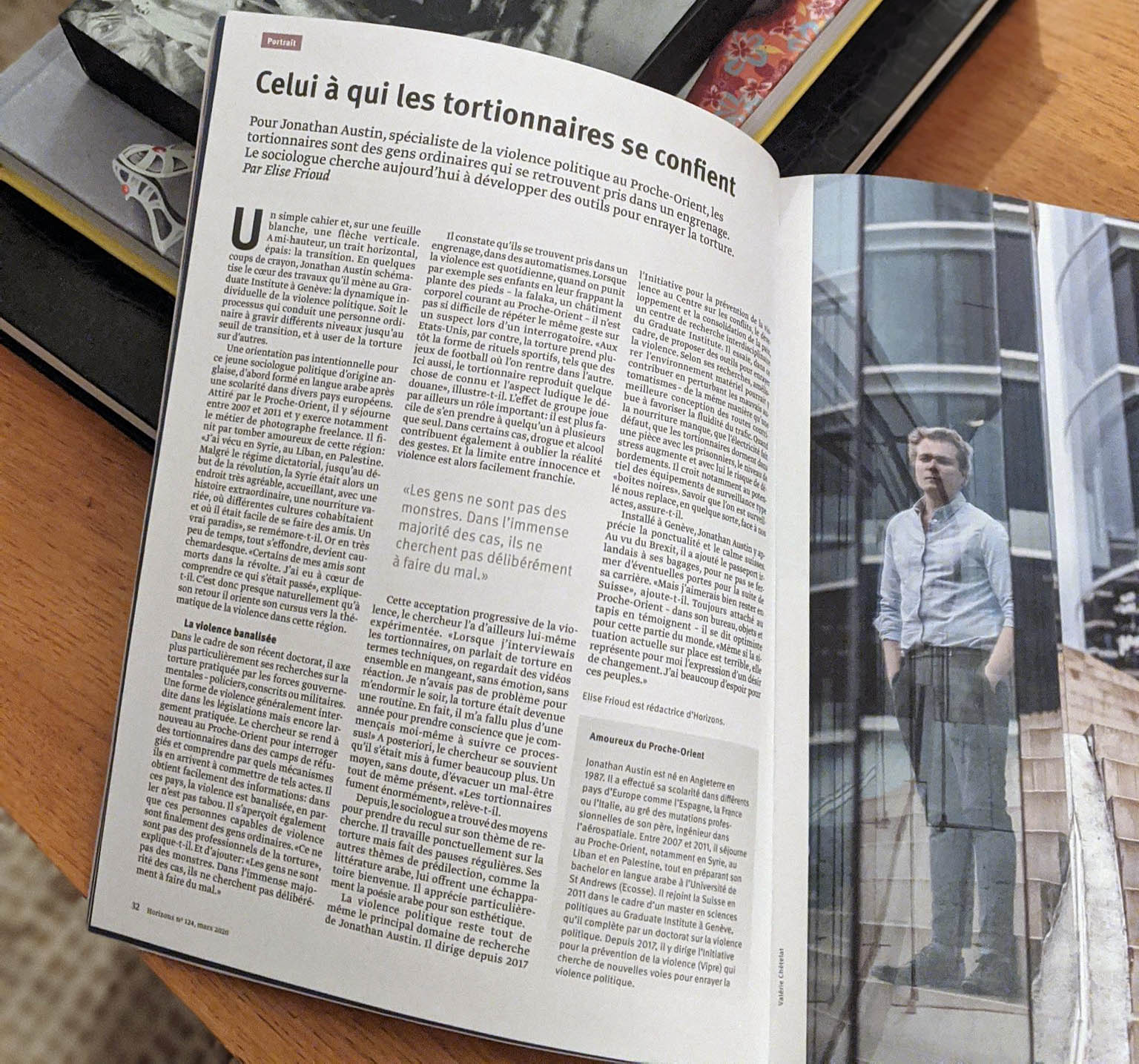
 Jonathan Luke Austin