Applied Research
Most of my career has been spent studying the social and political dynamics of phenomena that I would prefer did not exist; torture, war, conflict, humanitarian crisis. Because of this, my work has always had a second focus: applying research to practice. To achieve this, I engage collaborations far beyond my own discipline – with architects, development engineers, computer scientists, doctors, chemical engineers, and so on – as well as practitioners, in order to develop projects with applied impact. Below are a few examples of such projects, which I am currently developing.
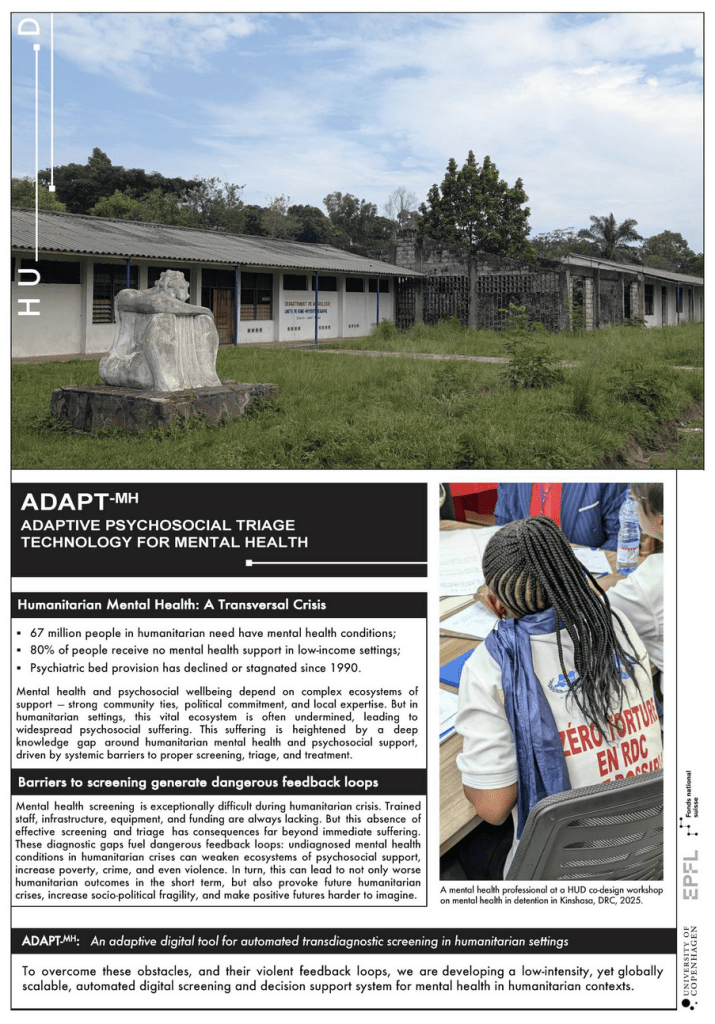
1. ADAPT-MH (adaptive psychosocial triage technology)
Over 65 million people in humanitarian need also suffer from a mental health condition, yet most are never diagnosed or treated due to extreme resource constraints. ADAPT-MH (Adaptive Psychosocial Triage Technology) addresses this gap. ADAPT-MH is a scalable digital system for automated psychosocial screening and triage in humanitarian contexts. It leverages machine learning to deliver clinical decision support, enabling task-sharing and stepped-care approaches to mental health services. Developed through key partnerships in the Democratic Republic of the Congo, Colombia, and South Africa, ADAPT-MH also draws on the expertise of humanitarian partners at the ICRC and Terre des hommes — all working toward one shared goal: reducing the global burden of mental health and psychosocial suffering.
ADAPT-MH is a result of my work as Principal Investigator for the Future of Humanitarian Design (HUD) research project. As part of HUD, I ETHNOGRAPHICALLY STUDIED ETC> EXPLAIN

2. VIOLENCE PREVENTION
At the core of my applied research has been developing novel approaches to violence prevention.
SOUSVEILLANCE TECHNOLOGY
3. VIPRE AND BECOMING ARTICLE RED CROSS
ADVANCED SORBENTS
2. CONSULTANCY (WORLD BANK)
 Jonathan Luke Austin