TEACHING
- Classes Taught
- PhD Supervision
- MA Supervision
- Formal Training
- Pedagogical Research
- Teaching Leadership
I have fifteen years experience teaching classes on global security, political violence, international conflicts, postcolonial politics, design methods, technological innovation, and more – at all levels (BA, MA, PHD). My pedagogical ethos is based on cultivating a classroom space in which students can create their own modes of learning. None of the classes I convene therefore involves lecturing students on particular theories, concepts, cases, or facts that they are expected to learn by heart and recite back in examinations. Instead, I hope to help students develop their own curiosity about the world, politics, and its problems. Simply put, I avoid ‘teaching’ in any traditional sense, favouring instead allowing students to pursue their own interests to the fullest.
For example, the ethos of the classes I teach on political violence and international conflicts are encapsulated in the idea that “there are no answers” (or, rather, there is no one answer) to the problem of political violence and global conflict. Instead of addressing conflict and violence through a set of pre-baked theories or concepts, these classes thus involve wide-ranging critical discussions of ethnographic texts, academic articles, non-fiction (short stories, poetry), and documentary films that offer insights into the ‘lived reality’ of these phenomena. Students are pushed to think differently about the phenomena, connecting political violence as it manifests itself in Kyiv, Baghdad, or Bogota back to their daily experiences in the streets of Europe.
Beyond the formal classroom, I have extensive experience leading and developing new education programs, coordinating among colleagues to teach collaboratively, and carrying out related activities. I have also run practical workshops on fieldwork and other research skills internationally. In recognition of these efforts, I have won teaching prizes and been consulted for pedagogical advice across my career.
1. Classes Taught
University of Copenhagen:
- Knowledge and Methods (7.5 ECTS, ~45 students, MA, 2022 – 2026)
- Approaches to International Conflicts: From Theory to Methods (15 ECTS, ~45 students, MA, 2022 – 2026)
- Global Violence and Political Evil (15 ECTS,~45 students, MA/BA, 2023)
- Knowledge Production and Evaluation (7.5 ECTS, MA, 2021)
- International Relations 2 – Theory (7.5 ECTS, ~300 students, BA, 2021 – 2026)
- International Relations 3 – Practice (7.5 ECTS, ~300 students, BA, 2021 – 2026)
- Concepts in International Relations (7.5 ECTS, ~90 students, MA, 2021 – 2026)
Geneva graduate institute:
- Art and Design Methods for the Social Sciences (6 ECTS, MA)
- Violence Without Borders (6 ECTS, MA)
- The Politics of Digital Design (3 ECTS, MA)
- Postcolonial Politics: Guerrillas, Dissident Intellectuals, and International Relations (6 ECTS, MA)
- Theories and Theorists of International Relations (6 ECTS, MA)
- Visual Archives of Violence (6 ECTS, MA)
- Designing Against Violence (9 ECTS, MA)
- Theory for Thought (No credit, directed social theory reading group, MA)
- Visual Global Security (6 ECTS, MA)
- Qualitative Methods in International Relations and Political Science (6 ECTS, MA)
- Violence, Memory and Cinema: Comparative Perspectives (6 ECTS, MA)
- Political Violence and Social Theory (6 ECTS, MA)
- Research Design and Qualitative Methods (6 ECTS, MA)
- Political Economy of Development (6 ECTS, MA)
- Negotiation and Regulation (6 ECTS, MA)
- Humanitarian Intervention and the Responsibility to Protect (6 ECTS, MA)
- Water Management: Global Theories, Local Realities (6 ECTS, MA)
Other
- Partir du Non-Humain: 6 ECTS, MA. Guest lecture for the course “La recherche ‘Hors-Cadre’», led by Stéphanie Perazzone, Global Studies Institute, University of Geneva.
- The Interiors of Humanitarian Design: Special participation in course at HEAD-Genève on architecture, humanitarianism, and design.
- Making Fieldwork Work: Invited teaching workshop, Institute for International Relations Prague;
- Savage Semiotics and War: Invited teaching workshop, University of Tartu;
- The Practice Turn and World Politics: Invited three day teaching workshop, Pontifical Catholic University of Rio de Janeiro.
2. Phd supervision
I have supervised or co-supervised nine doctoral candidates across my career in different capacities.
- Maevia Griffiths, 2023 –
Filmmaking as a tool of ‘presencing’ between materiality, affect and violence.
The University of Copenhagen. - Nijat Eldarov, 2022 –
Conceptualizing security devices through critical new materialisms.
The University of Copenhagen. - Nora Doukkali, 2024 –
Practicing time in humanitarian waiting-scapes.
The Graduate Institute of International and Development Studies Geneva. - Thomas Gmür, 2019 – 2024
Dysfunctional Democracy: Towards and Ergotherapy of the Political
The Graduate Institute of International and Development Studies, Geneva;
Defended summa cum laude with the congratulations of the jury. Now Senior Researcher at the University of Lausanne. - Alice Baroni, 2017 – 2022.
Imperfect Struggles: Jewish-Israeli Activists for Palestinian Rights and the Paradoxes of Solidarity from a Position of Power.
The Graduate Institute of International and Development Studies, Geneva;
Defended summa cum laude with the congratulations of the jury, Winner of the American Political Science Association (APSA), Middle East Studies Section Best Dissertation Award. Now Senior Researcher at the TechHub, Graduate Institute, Geneva. - Miguel Iglesias Lopez, 2017 – 2021
International Borderwork: Politics of the Margins in EU Border Management Assistance in Central Asia;
The Graduate Institute of International and Development Studies, Geneva;
Defended summa cum laude, now Senior Assessment Officer at IMPACT Initiatives (Ukraine). - Asees Puri, 2018 – 2024
To/For Syrialism: (Re)Tracing the Affective and Sensory Experience of Martial Violence in Syria
The Graduate Institute of International and Development Studies, Geneva;
Defended cum laude, now program officer at IMPACT. - Massimiliano Masini, 2022 – 2024
Commemorating internationalist volunteers
The Graduate Institute of International and Development Studies, Geneva; - Basil Farraj, 2017 – 2019
The Graduate Institute of International and Development Studies, Geneva;
Supervisor during role as doctoral assistant for the Violence Prevention (VIPRE) Initiative;Now Assistant Professor at Birzeit University, Palestine.
3. ma supervision
Since 2017, I have also supervised approximately 10 MA dissertations each academic year. This includes MIA, MDEV, and disciplinary MA dissertations at the Graduate Institute of International and Development Studies, Geneva, as well as MA in Political Science and MA in Security Risk Management dissertations at the University of Copenhagen.
4. Formal pedagogical training
In 2022, I completed the ‘Teaching and Learning in Higher Education Programme’ (TLHEP) at the University of Copenhagen. The TLHEP is a Danish-government certified training programme designed to provide training to ensure the best possible organization, provision, and evaluation of teaching practices in higher education. This included both a focus on practical teaching tools, drawing on cutting-edge pedagogical methods, and more in-depth theoretical and conceptual work on the foundations of good pedagogy. The programme involved approximately 175 hours of intensive pedagogical training.
5. pedagogical research
6. teaching leadership
I am currently (2025 -) Head of Studies for the University of Copenhagen’s Security Risk Management (SRM) MSc. The SRM program is a unique interdisciplinary education that combines high-theoretical knowledge from the social sciences to real-world security and politics. In this, it connects critical thinking to practical action. It is a highly international program, with students from across the world attending. In my role as Head of Studies, I manage a teaching team of ten, coordinate with the entire student body, and lead the program’s development. At the moment, I also lead the planned transformation of the program from a two-year to a one-year program, following a mandate from the Danish government. This has involved carefully re-calibrating the program to maintain its strong student and employer community while furthering its goal of linking critique to practice in difficult geopolitical times.
- In 2024, I was awarded the Teacher of the Year Award at the University of Copenhagen.
- In 2023, I was nominated for the University of Copenhagen’s Teacher of the Year Award. I was nominated by students for providing teaching that makes an “extraordinary contribution to achieve a high level of commitment, critical reflection, and a high academic level among students.”
- From 2022 onwards, I am the leader of the programme specialization ‘Conflict Resolution and International Relations’, which forms part of the University of Copenhagen’s MA in Political Science. I coordinate the specialization, conduct all administrative tasks, coordinate with lecturers and teaching assistants, prepare the substantive content of the specialization, and ensure it is constructively aligned with other aspects of the MA in Political Science;
- From 2022, I have collaborated with the Head of Studies at the University of Copenhagen (Lars Tønder) and faculty colleagues to improve the integration of research and teaching within the MA in Political Science. This has focused on revising the Conflict Resolution and International Relations specialization to focus on the development of research skills (both academic and non-academic) that will be applicable for their future careers.
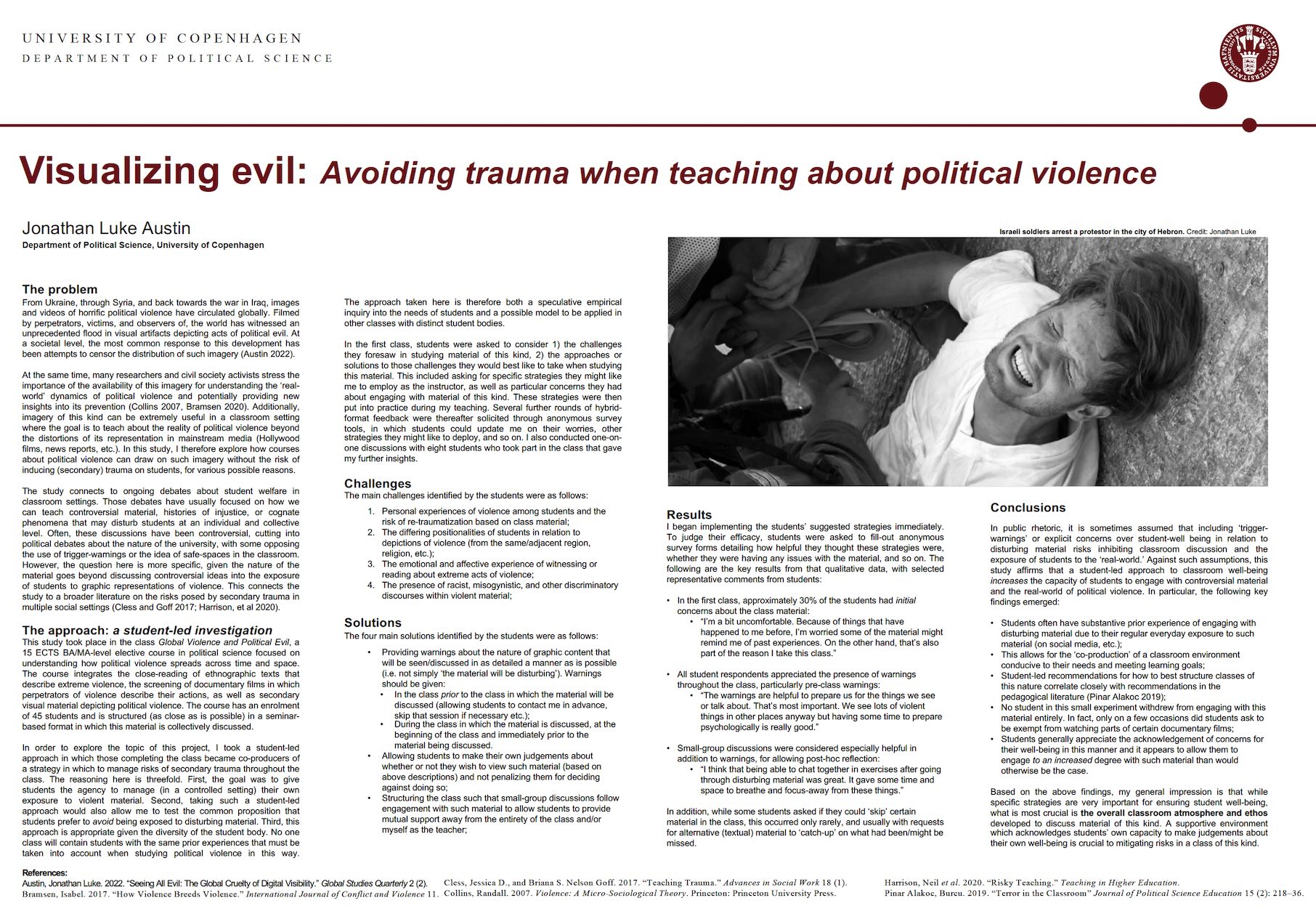
- In 2022, I conducted a teaching research project – Visualizing evil: Avoiding trauma when teaching political violence – which focused on the challenge of teaching political violence to university-level students in our hyper-mediated contemporary violence. Exposure to images of political violence is commonplace, and is also an increasingly important part of research in the field. This project explored pedagogical strategies for integrating such material without doing harm to students;
- Between 2017 and 2021, I co-convened a directed social theory reading group – Theory/Thought – that introduced graduate students (MA and PhD level) to cutting-edge theoretical texts of relevance to their studies. The programme was outside the formal curriculum but designed to provide skills otherwise attainable to students. The average attendance during the programme was approximately ten students each semester.
 Jonathan Luke Austin