RESEARCH AGENDA
Why is violence such an intimate part of life? From its most dramatic manifestations – war, torture, genocide – down to its most hidden forms – intimate partner violence, social exclusion, and poverty? Why do political regimes of all types – democratic, autocratic, dictatorial – continue to be plagued by this burden? Why is violence truly global?
These questions and their global politics are at the heart of my research agenda. To approach them, I have always begun with political theory – where variations on their themes have always haunted philosophy. Yet, when speaking of violence, theory alone can be too abstract. I have thus always followed what I would term an applied theoretical tradition encapsulated by voices like Arendt, who watched Eichmann up-close, Fanon, who studied the Algerian war as a participant, or Sartre and de Beauvoir, who theorized Cuba’s revolution from Havana, not only Paris. It is this idea that theory must make ‘contact’with the world to understand and illuminate its problems that has most informed my research interests. In short, it is through a certain applied dance between theory and the world that my research has evolved, leading me to mix political theory with empirical inquiry, and – eventually – direct engagement with applied interventions against violence. Below, I outline how this has manifested to date, and my plans for its future evolution.
1. Going deep: Theorizing Global Violence
1a. Why does violence converge across regime type?
Long at the core of my research is the question of how entirely institutionally distinct political regimes – democratic/autocratic, capitalist/socialist, liberal/illiberal, etc. – frequently converge nonetheless in their deployment of almost identical practices and patterns of violence. For example, North Korea uses the same torture techniques as the United States. Russia uses the same modes of ‘population control’ in Ukraine as Israel does in Gaza. Great Britain deployed concentration camps in the Boer war, before Nazi Germany did during the Holocaust. And so forth.
My work has theorized these dynamics by drawing on Actor-Network Theory, Science and Technology Studies (STS), and pragmatist philosophy. Specifically, I have developed a so-called ‘New Materialist’ theorization of political violence that explores its convergence across space as driven not only by human agency or intentionality, but also the guiding force of global material-technological infrastructures, a strong unconscious desire for perpetrators of violence to minimizerisks to their psychological well-being, and the heavy weight of the historical inscription of violence into a certain global ‘archive’ or ‘memory’ of humanity.
To ‘get close’ to this theory, I have spent over ten-years longitudinally studying – through interviews, ethnography, and visual analysis – Syrian, Iraqi, Argentinian, US, and Congolese perpetrators of torture and other war crimes. In doing so, I have demonstrated not the irrelevance of regime type but, rather, the malleability of institutions to global structures. Or, put differently, I trace the weakness of the liberal reliance on human rights beyond Arendt’s focus on political membership towards the role of these three elements (technology, human psychology, and the archiving of violence into our history) in injecting an inertia that forestalls dreams of abolishing political violence. Notably, this research has wider relevance: precisely the same tendency towards a convergence in the behaviour of political regimes is seen in the rise of the far right and the decline of the liberal international order.

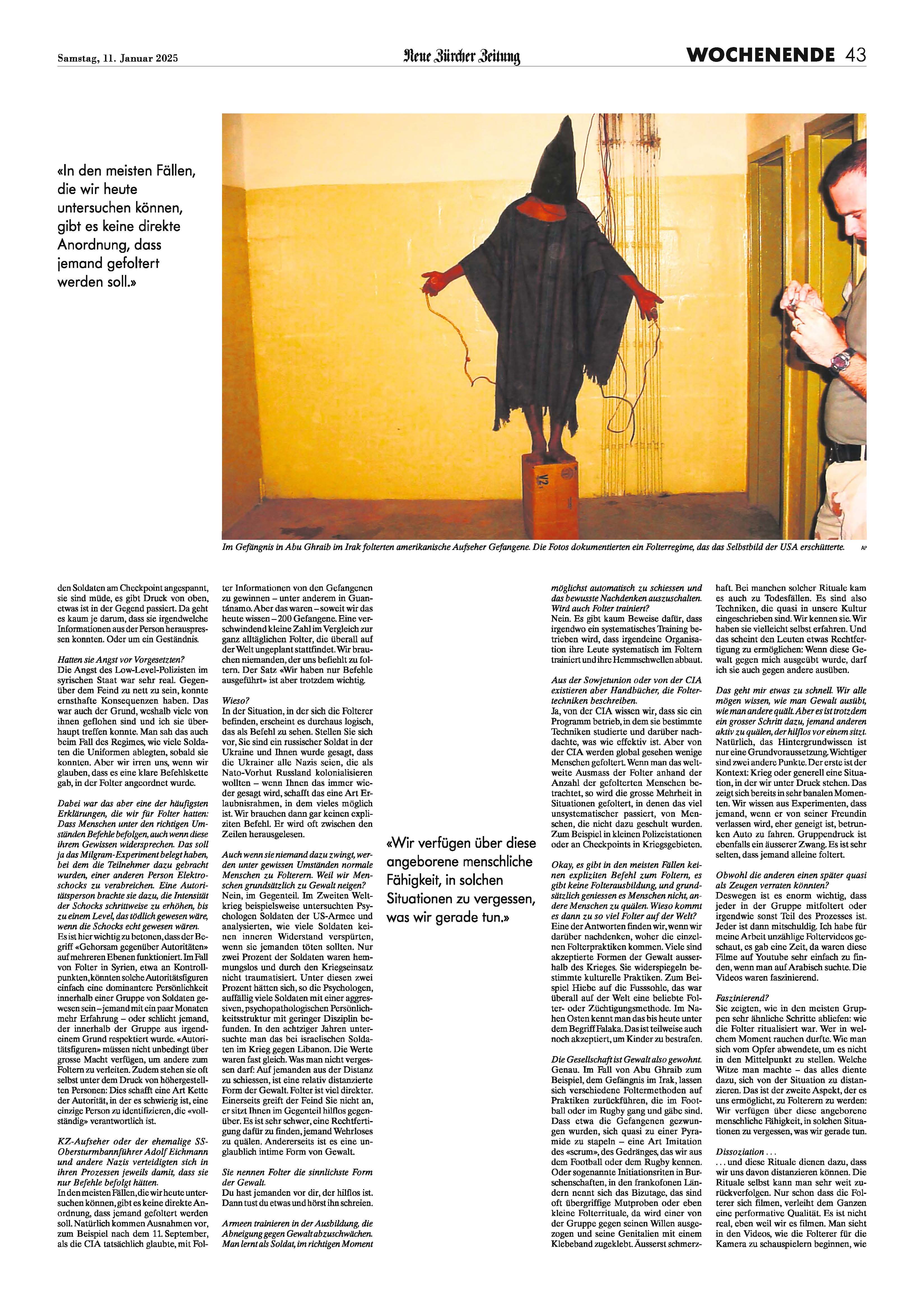
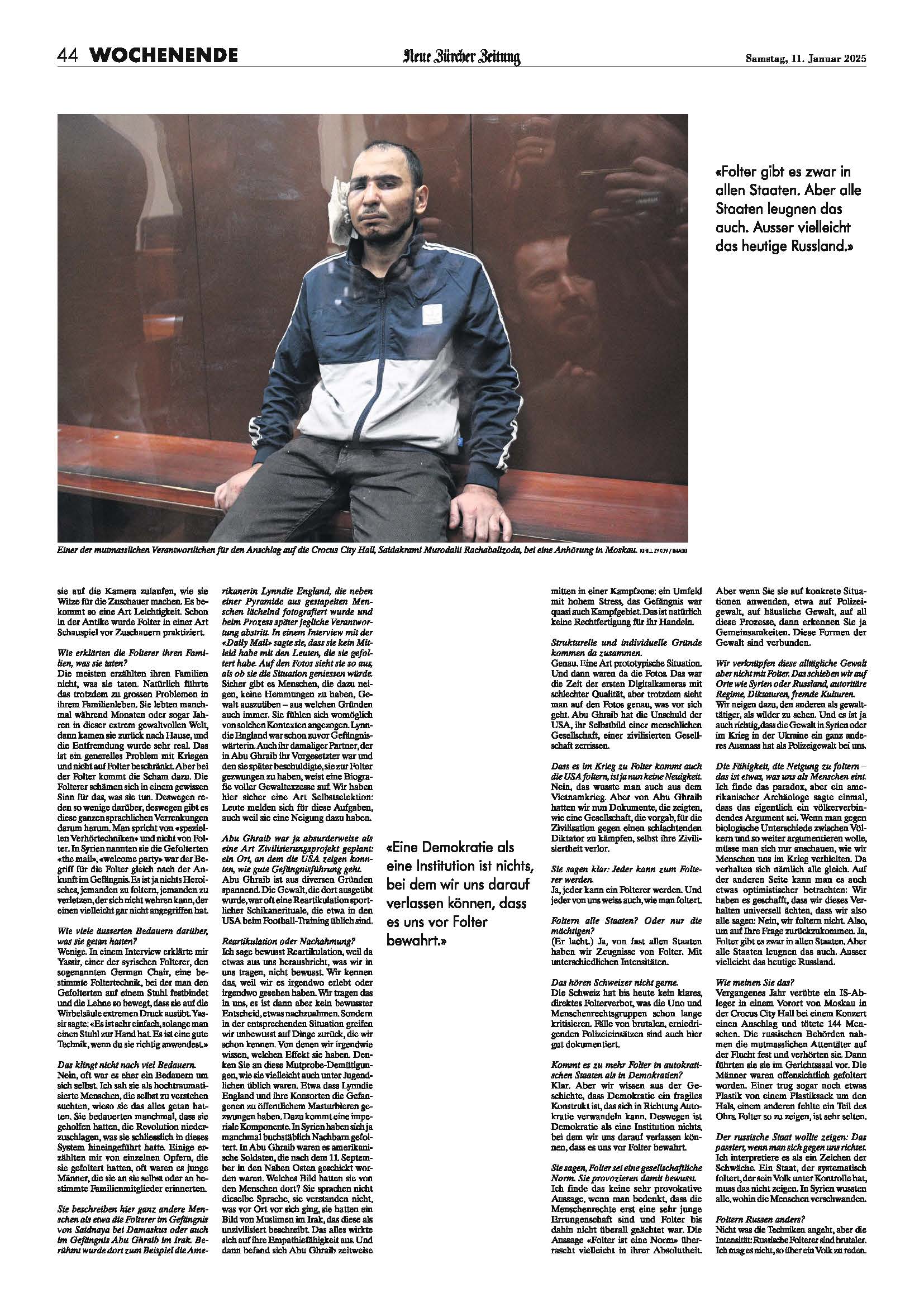
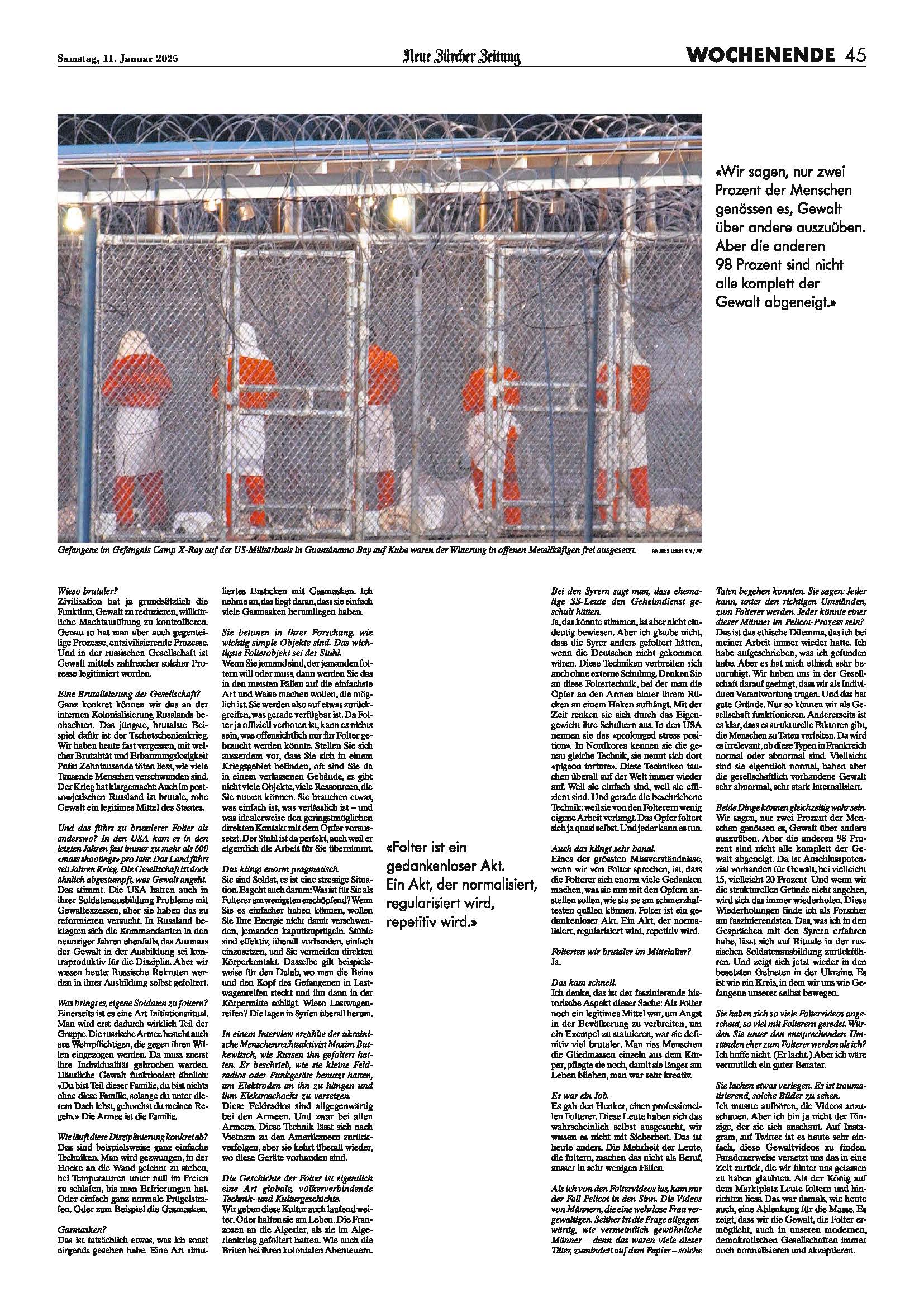
Above: A full-length research profile of my work on political violence published at Neue Zürcher Zeitung (NZZ).
1b. Madness and Psychosocial Suffering in Global Politics
Recently, my research has shifted from a focus on the more ‘brutal’ forms of violence that the world faces towards the connections between these phenomena and hidden yet equally pernicious forms of violence: social exclusion, poverty, gang violence, intimate partner violence, etc. Indeed, in Frantz Fanon’s classic The Wretched of the Earth, a relatively unnoticed appendix details his experience giving psychological treatment to a French perpetrator of war crimes who is seeking help because he cannot stop beating his wife and children. It is this dynamic in which political violence ‘bleeds’ into wider socio-political violence – and becomes, as Césaire once described it, a social “poison” – that I have become increasing concerned with.
A core strand of my research thus currently theorizes the roles mental health, psychosocial distress, and psychological trauma play in the spread of violence. Specifically, I draw on Loic Wacquant’s discussion of a ‘carceral continuum’ connecting violence in detention to social exclusion outside the prison walls, but adapt it beyond the context of the United States, drawing on Caribbean ‘psychohistoriographic’ theory to better attend to the long lines linking the violence of colonialism to the epigenetic trauma of, say, street children in postcolonial societies today, through to criminality, gang violence, armed conflict, and beyond.
My core concern is to connect questions of local trauma – the experience, say, of a single-family suffering from intimate partner violence in Damascus, Goma, or Medellin – back to global politics. To do so, I am conducting longitudinal ethnographic research with mental health professionals in the Democratic Republic of the Congo to theorize how a neglect of psychosocial care is at the centre of global violence. In particular, I also draw on Achille Mbembe’s concept of the ‘codified madness’ of the postcolonial world, combined with Suzanne Cesaire’s surrealist philosophy, to constructively-critically engage the dominance of ‘global mental health’ perspectives in policymaking.

1c. Theorizing Violence Prevention Beyond the Law
You should not drive a car while drunk. That’s illegal. And you’ll be arrested if you get caught. But what if you are an alcoholic? If you’ve had a breakup? If you are going through some kind of crisis? Because in those situations people do drive drunk, and the police or other authorities know this. Thus; protective crash barriers reduce deaths from drunk drivers, ‘rumble strips’ on the side of the road wake up drivers who have nodded off, and the car beeps if you don’t wear a seatbelt. Protection against the worst remains in place.
This description of how we prevent death and injury on the road – both through legal mechanisms and material infrastructures – has long fascinated me in its contrast to how we think about political violence prevention: primarily legally, through instruments like international human rights law. Indeed, a logical question raised by my focus on the ‘globalization’ of violence across regime type is: So, what is to be done?
A core element of my research agenda is thus theorizing alternative extra-juridic forms of violence prevention. Two approaches have been central. The first draws on material-semiotic theory, following my work with actor-network theory, combined with insights from behavioural science and aesthetics, to imagine ways of ‘nudging’ potential perpetrators of political violence towards non-violence. More recently, I have expanded that approach through an interdisciplinary engagement with the field of preventive medicine, which studies the diseases of the body not as discrete problems but as population-level problems. In this view, we should not ask ‘if’ someone has a disease, but ‘how much of a disease’ someone has – considering risk factors such as, say, poverty in the likelihood of smoking leading to cancer, rather than seeing disease as a discrete entity. In my work, I theorize a similar application vis-à-vis violence prevention, especially in my applied work on mental health (see below).
1d. Imagining Humanitarian Futures
You should not drive a car while drunk. That’s illegal. And you’ll be arrested if you get caught. But what if you are an alcoholic? If you’ve had a breakup? If you are going through some kind of crisis? Because in those situations people do drive drunk, and the police or other authorities know this. Thus; protective crash barriers reduce deaths from drunk drivers, ‘rumble strips’ on the side of the road wake up drivers who have nodded off, and the car beeps if you don’t wear a seatbelt. Protection against the worst remains in place.
This description of how we prevent death and injury on the road – both through legal mechanisms and material infrastructures – has long fascinated me in its contrast to how we think about political violence prevention: primarily legally, through instruments like international human rights law. Indeed, a logical question raised by my focus on the ‘globalization’ of violence across regime type is: So, what is to be done?
A core element of my research agenda is thus theorizing alternative extra-juridic forms of violence prevention. Two approaches have been central. The first draws on material-semiotic theory, following my work with actor-network theory, combined with insights from behavioural science and aesthetics, to imagine ways of ‘nudging’ potential perpetrators of political violence towards non-violence. More recently, I have expanded that approach through an interdisciplinary engagement with the field of preventive medicine, which studies the diseases of the body not as discrete problems but as population-level problems. In this view, we should not ask ‘if’ someone has a disease, but ‘how much of a disease’ someone has – considering risk factors such as, say, poverty in the likelihood of smoking leading to cancer, rather than seeing disease as a discrete entity. In my work, I theorize a similar application vis-à-vis violence prevention, especially in my applied work on mental health (see below).

2. Getting close: co-theoretical design and methodological pluralism
Following my ethos of applied theoretical inquiry, my empirical engagement with the world has been premised on ‘getting close’ to violence, in all its forms, in order to better conceptualize its dynamics. Over my career, this has involved ethnographic work with ‘real-world’ perpetrators of torture and terrorism, the microsociological analysis of perpetrator-filmed videos of war crimes, longitudinal studies with mental health and psychosocial professionals, and deep engagement with the work of humanitarian practitioners.
Some of this work has sought – in the more classical methodological sense of political science – to gain granular data on the phenomena I theorize, data that is in short supply. But I have also always seen this work as about the co-design of political theory. This relates to my work on ‘critique’ in social science, where I have published a series of agenda-setting articles that seek to expand the realm of what ‘counts’ as critical thought in social science and even to be somewhat critical of my intellectual home in critical theory.
Concretely, my most recent work, for instance, has involved convening workshops with mental health professionals in Kinshasa and Goma, the Democratic Republic of the Congo, where the violence of psychosocial suffering was theorized from the ground. During those events, I forged collaborations with mental health professionals who introduced me to the literature on Caribbean psychology that we then adapted with the work of Wacquant to theorize the effects of psychosocial distress on global violence.
Much of my work in this regard has been qualitative – ethnography, interviewing, visual analysis, and so forth. Yet, methodological pluralism is close to my heart. For instance, I have also worked quantitatively through the construction of two data sets that code an archive of approximately 1’000 ‘real-life’ videos of torture and war crimes produced during the Syrian civil war. My current work on humanitarianism also involves deploying machine learning tools, in collaboration with engineering scientists. Methodologically, then, I generally avoid any strict alignment with intellectual ‘schools,’ eschewing bias towards one or another per se.
Reflecting my interest in a truly ‘global’ perspective on international relations, I have also orientated my empirical work towards the cross-national study of regimes from entirely distinct contexts. This includes work in the Middle East (Iraq, Syria, Lebanon), Africa (Democratic Republic of the Congo, Rwanda, Kenya), and Latin America (Colombia, Brazil).

3. making change: applied intervention
Theory allows us to imagine the world differently. Empirical study gets us closer to those imaginaries, judging their validity. But how do we realize them? Build something different? Change the world? Given my focus on violence, these questions are ever-more central to my work; cultivating a desire to demonstrate how theory can translate into concrete practice. Today, I engage this goal in two interconnected ways.
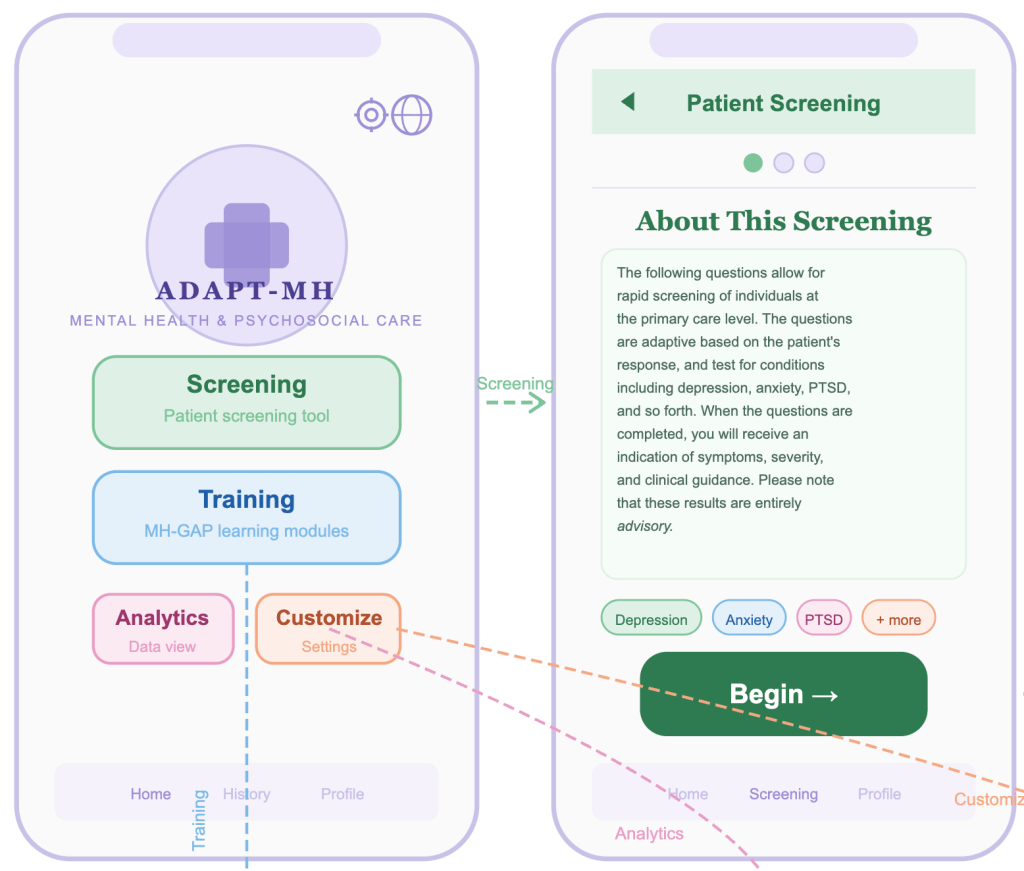
First, I founded a cross-institutional technical working group with members from the ICRC, IFRC, Terre des hommes, the hôpitaux universitaires de Genève (HUG), and others – in consultation with WHO experts. The working group focuses on developing an electronic clinical decision support system for mental health and psychosocial support in humanitarian contexts – called ADAPT-MH for Adaptive Psychosocial Triage Technology for Mental Health. Currently at the prototype stage, and being tested in South Africa, Kenya, and the Democratic Republic of the Congo, the tool represents a concrete ‘practical’ output of my theorization of mental health and political violence, described above. A small hopeful step to reducing global violence.
Second, and following my work on the co-design of political theory, I am working with social scientists, artists, and architects at the Académie des Beaux-Arts de Kinshasa, Democratic Republic of the Congo, to convene a competition/‘concours’ in January-February 2027 entitled Technical Dreams: Afrofuturism for Humanitarianism. The event will convene young artists to create physical models – drawing on different artistic mediums – that evoke a future for the Congo outside political violence and humanitarianism. In this, it is an attempt to intervene from the global south/majority into the imaginaries of world politics.